

 Ελληνικά
 Deutsch
 Français
 Italiano
Rent a Car in Heraklion City
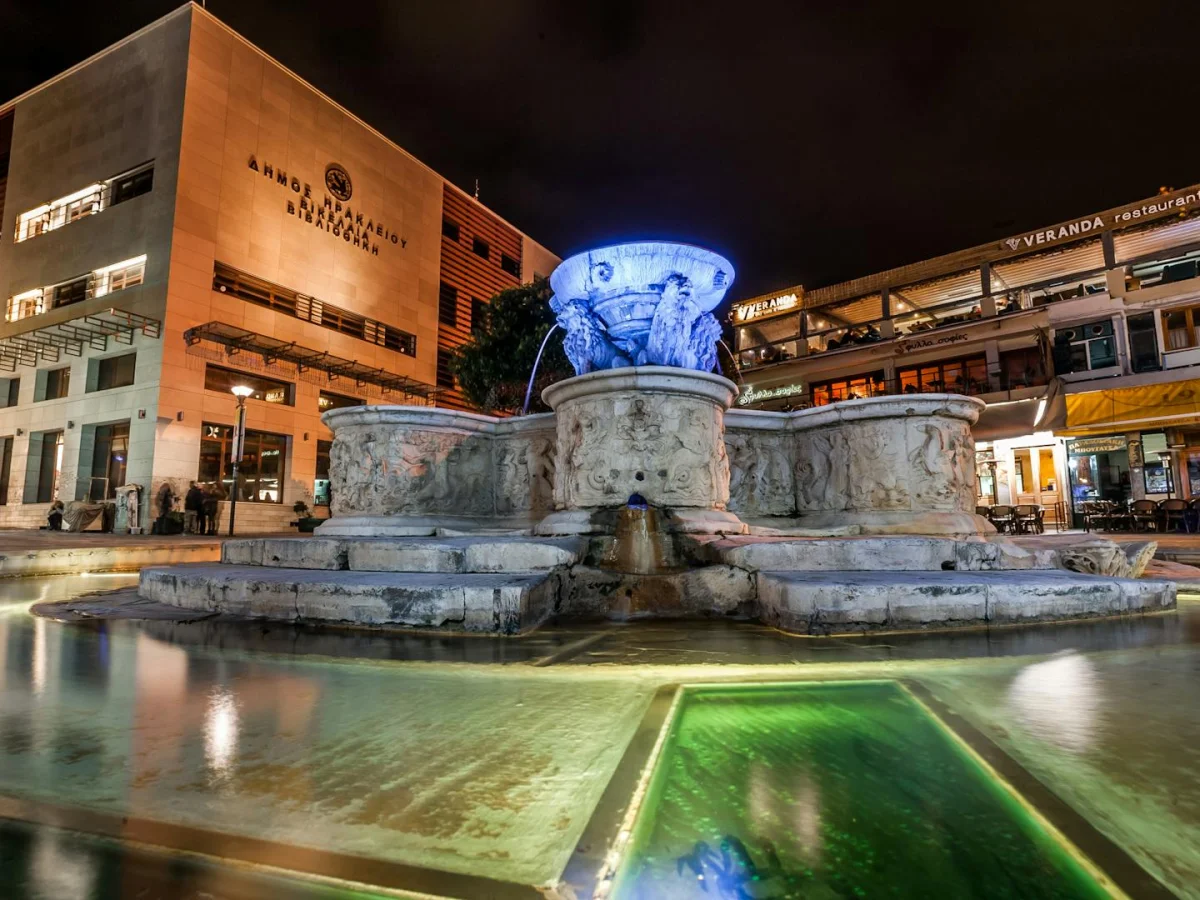
History & Urban Depth
Heraklion is a city shaped by continuity rather than spectacle. Its scale, rhythm, and layers reveal a place that has evolved steadily, absorbing centuries of change without losing coherence. Here, history does not sit apart from daily life; it remains woven into streets, walls, and routines.
The origins of the city extend deep into Minoan civilization. Just beyond the urban fabric lies Knossos, a site that reflects the early organization, movement, and thought that once defined the region. This proximity between ancient settlement and modern city is not symbolic: it is spatial, tangible, and constant.
Later periods added new dimensions rather than replacements. Arab, Venetian, and Ottoman influences reshaped the city’s structure and defenses, leaving behind fortifications, harbor landmarks, and enclosed neighborhoods. The Venetian walls still trace the outline of the city, not as monuments, but as quiet boundaries between past intention and present life.
Heraklion did not grow through idealization. It expanded through function, trade, and adaptation. This practical evolution created a city that feels grounded, where movement follows purpose and public space reflects use rather than display.
Travel & Quiet Movement
Exploring Heraklion City by car supports a form of travel that values direction over speed. Renting a car in Heraklion allows movement to unfold without urgency, making it possible to leave the city gradually rather than abruptly.
Within the city, walking often feels sufficient. Neighborhoods connect naturally, and daily life reveals itself through cafés, markets, and streets that do not demand attention. A car becomes relevant not for distance, but for choice: the choice to leave early, late, or not at all.
Short drives beyond the city reveal contrasting environments. Inland routes move through cultivated land and quieter settlements, where the city’s influence softens into rural rhythm. These transitions are subtle, best experienced without schedules or fixed expectations.
Driving south introduces wider space and different light. The landscape opens slowly, shifting toward the Libyan Sea, where terrain and climate change without announcement. The journey itself becomes a moment of recalibration rather than a destination‑driven task.
Returning to Heraklion after these drives feels natural rather than final. The city receives movement without absorbing it, allowing visitors to pass through, pause, and continue without friction. This quality makes Heraklion City particularly suited to travelers who prefer orientation over immersion.
Renting a car in Heraklion City is not about covering the island. It is about maintaining agency deciding when to remain still and when to move. In a city defined by layers, balance, and continuity, travel becomes quieter, more intentional, and closely aligned with personal rhythm.